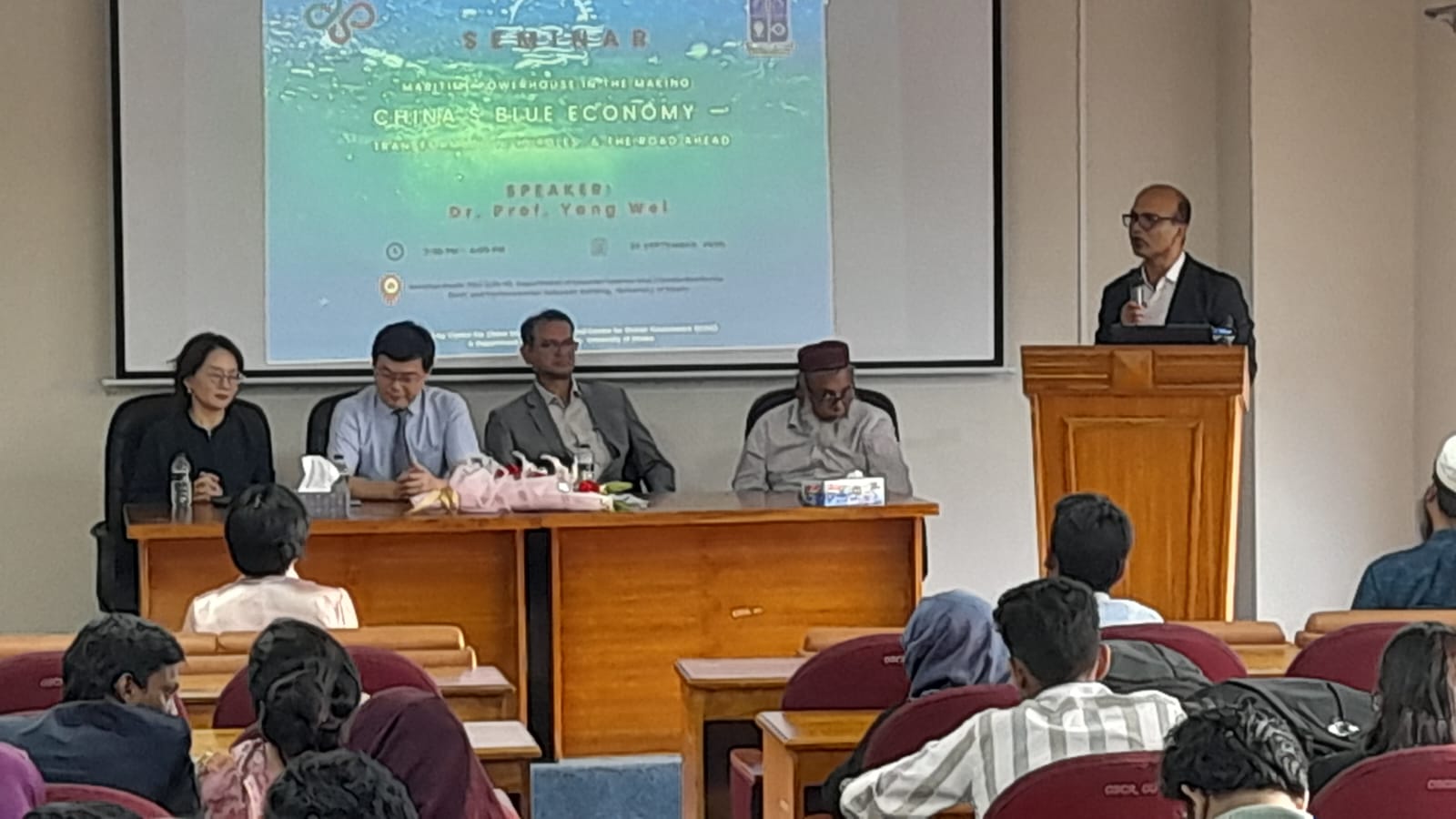
University of Dhaka to Host Seminar on China’s Blue Economy—Transformation, Hurdles, and the Road Ahead
The Centre for China Studies (CCS), the International Centre for Ocean Governance (ICOG), and the Department of Oceanography, University of Dhaka, are jointly organizing a seminar this afternoon titled “Maritime Powerhouse in the Making: China’s Blue Economy — Transformation, Hurdles, and the Road Ahead.” The seminar aims to share knowledge and perspectives on the transformation, challenges, and future prospects of China’s blue economy with faculty, researchers, and students from different institutions and departments at the University of Dhaka.
The seminar will be graced by the presence of the Dean, Faculty of Earth and Environmental Sciences. Dr. K M Azam Chowdhury, Associate Professor, Department of Oceanography, and Director of ICOG, will moderate the session. Associate Professor Yang Wei of Shanghai Ocean University, who also serves as Deputy Director of the China Fisheries Development Strategy Research Center, will deliver the keynote presentation. The programme will also feature remarks by the Chairman, Department of Oceanography, and the Director, Centre for China Studies.
In his remarks, the Dean is expected to reflect on how China's experience in balancing industrial growth with ecological protection resonates with Bangladesh's own work on climate adaptation and disaster resilience across its coastal regions.
The seminar will also be attended by a visiting delegation from Shanghai Ocean University, including Professor Jin Hongtao, Associate Dean of the College of Economics and Management, and Professor Liao Zefang, Head of the Department of Applied Economics, along with faculty and researchers from the Centre for China Studies, ICOG, and the Department of Oceanography, University of Dhaka. More than a hundred participants are expected to attend.
The seminar reflects the deepening academic and research cooperation between Bangladesh and China, and organizers expressed hope that it will pave the way for continued exchange, joint research, and stronger institutional ties between the two countries in the years ahead.