Second China-Bangladesh Roundtable on Governance Experience Exchange
DU VC emphasized on strengthening cooperation between Bangladesh and China in ocean resources, disaster management and sustainable development
Dhaka University Vice-Chancellor Professor Dr. A. B. M. Obaidul Islam stressed the need for strengthening cooperation between Bangladesh and China in ocean resource management, climate change, disaster risk reduction, early warning systems, technology and human resource development alongside education and research.
He said new opportunities for practical cooperation could be created through exchange of knowledge and experience among universities, research institutions and relevant organizations of the two countries.
He made the remarks while speaking as a Special Guest at the Second China-Bangladesh Roundtable on Governance Experience Exchange, held on Monday, 21 September 2026, at the Crystal Ballroom of InterContinental Dhaka. The event was jointly organized by the Center for China Studies (CCS), Shanghai Institutes for International Studies (SIIS), University of Dhaka, OCPASS and Bangladesh Institute of International and Strategic Studies (BIISS).
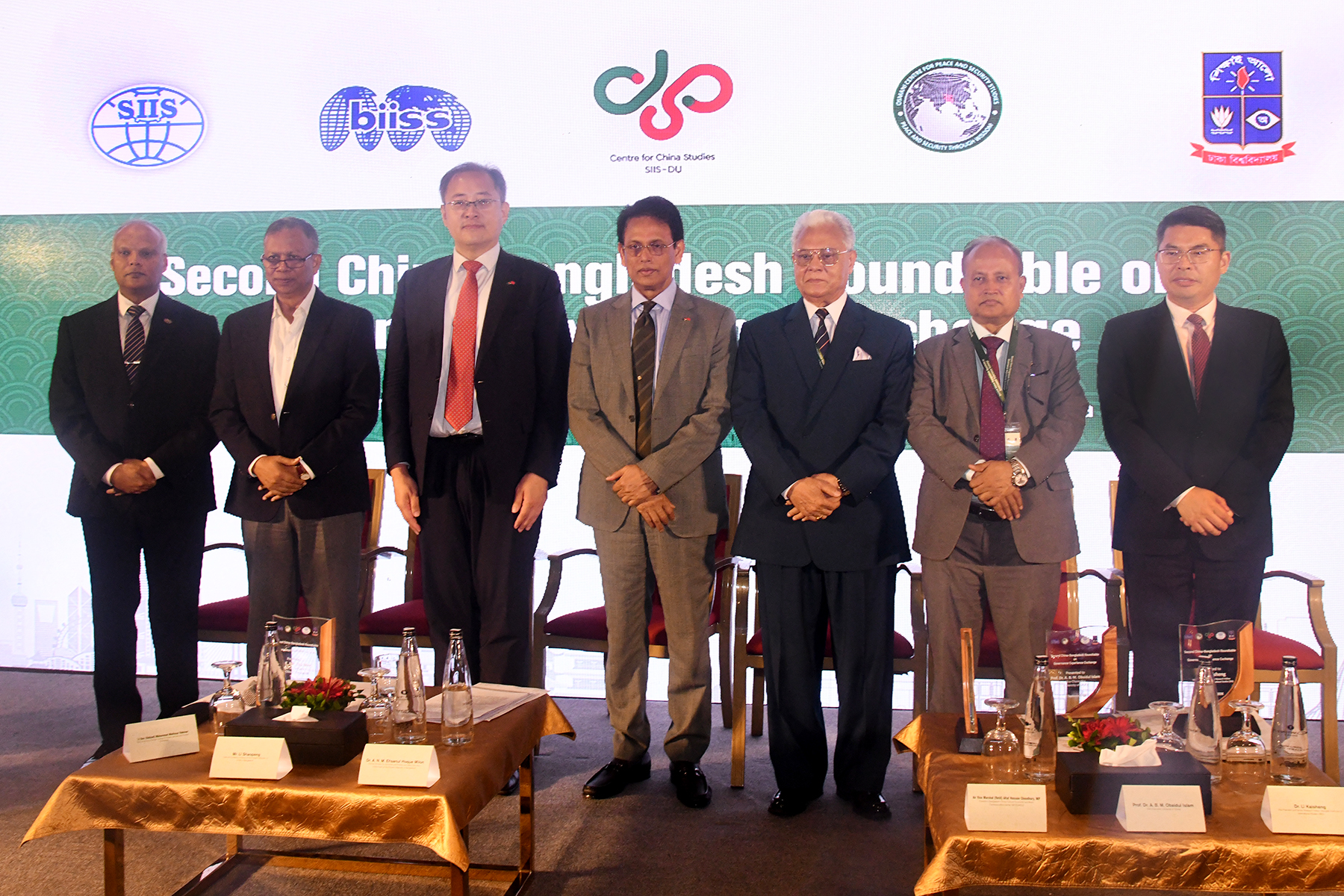
Education and Primary and Mass Education Minister Dr. A. N. M. Ehsanul Hoque Milon attended the event as the Chief Guest. Other Special Guests included Professor Dr. A. B. M. Obaidul Islam, Vice-Chancellor of the University of Dhaka; Dr. Li Kaisheng, Vice President and Senior Research Fellow of the Shanghai Institutes for International Studies. Air Vice Marshal (Retd.) Altaf Hossain Chowdhury attended the event as the Guest of Honor.
Professor Dr. A. B. M. Obaidul Islam said that since its establishment, the University of Dhaka has been playing an important role in higher education, research and intellectual exchange. Alongside knowledge creation and dissemination, the University places importance on expanding international cooperation. He said the longstanding friendly relations between Bangladesh and China could be transformed into more effective cooperation through education, research and institutional partnerships.
Highlighting the potential of the blue economy and sustainable maritime development, the Vice-Chancellor said these could be important areas of opportunity for Bangladesh. He emphasized that realizing the potential of fisheries, maritime transport, coastal development, maritime infrastructure and other ocean-based sectors requires scientific research, reliable data, skilled human resources and effective governance.
He said China's experience in marine research, engineering, fisheries and aquatic resource management and infrastructure development could be valuable for Bangladesh. At the same time, Bangladesh's experience in coastal adaptation and managing densely populated coastal areas could also be shared with China. He mentioned that the University of Dhaka and China's First Institute of Oceanography (FIO) have recently renewed two Memoranda of Understanding aimed at further expanding cooperation in ocean science, ocean observation, forecasting,
climate research and disaster resilience.
Regarding climate change and disaster management, Professor
Obaidul Islam said Bangladesh has gained significant experience in dealing with cyclones, floods, river erosion and other natural disasters. China, on the other hand, has extensive experience in disaster monitoring, technology and infrastructure management. By bringing together the experiences of the two countries, effective initiatives could be undertaken to strengthen early warning systems, reduce disaster risks and enhance climate resilience.
He also emphasized the importance of strengthening communication among researchers, policymakers and professionals of the two countries through various departments and research centers of the University of Dhaka. He sought greater cooperation from relevant Chinese institutions, particularly in the fields of ocean science, climate change, disaster management and technology.
In his speech as the Chief Guest, Education and Primary and Mass Education Minister Dr. A. N. M. Ehsanul Hoque Milon said that education and human resource development could play an important role in further strengthening Bangladesh-China relations. He emphasized the need to establish effective linkages among education, technology, research and industry to transform Bangladesh's large young population into skilled human resources. He also noted that Bangladesh could learn from China's development experience.
Guest of Honor Air Vice Marshal (Retd.) Altaf Hossain Chowdhury said Bangladesh-China relations should be further expanded beyond government-to-government cooperation through education, research, technology and people-to-people connectivity. He emphasized that alongside infrastructure and technological investment, sound policies, effective institutions, management capacity and implementation capabilities are essential for sustainable development.
At the roundtable, experts and researchers from Bangladesh and China exchanged views on governance and development experiences, the blue economy, climate change, disaster risk reduction, education, research, technology and human resource development. Various opportunities for further expanding institutional cooperation between the two countries were also discussed.
It may be mentioned that the first Bengali edition of “Keywords to Understand the Common Development in Asia” was launched at the event with the aim of promoting the exchange of ideas and experiences on common development in Asia. The book contains 85 entries organized into four sections and highlights the common development perspectives and initiatives of Asian countries. Several copies of the book were also handed over to the University of Dhaka Library.

21/09/26
Forrukh Mahmud
Deputy Director
Public Relations Office
University of Dhaka