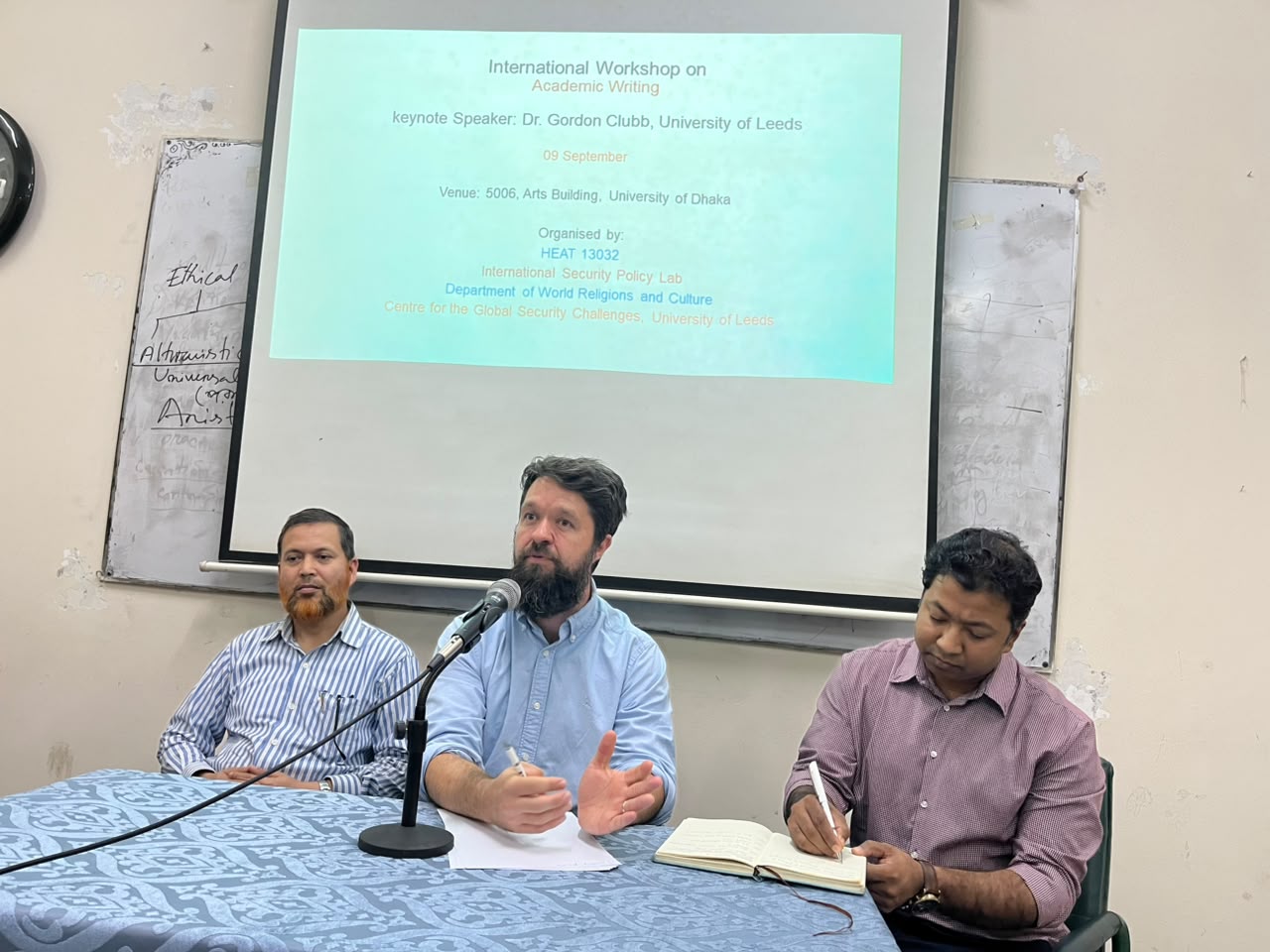
International Workshop on Academic Writing Held at University of Dhaka
Dhaka, 10 September 2026: An International Workshop on Academic Writing was held at the University of Dhaka on 10 September 2026, featuring Professor Dr Gordon Clubb, School of Politics and International Studies, University of Leeds, as the keynote speaker. The session was chaired by Professor Dr Md Abu Sayem, Chairman, Department of World Religions and Culture, University of Dhaka.
The international workshop was organised by the International Security Policy Lab under HEAT Sub-Project 13032, the Department of World Religions and Culture, University of Dhaka, and the Centre for the Global Security Challenges, University of Leeds. Dr Md Didarul Islam, Assistant Professor, Department of World Religions and Culture, and Research Director, International Security Policy Lab, University of Dhaka, participated actively in the workshop and subsequent discussion.
Professor Clubb's session provided valuable insights into the craft of academic writing, particularly focusing on developing strong scholarly arguments, constructing new theoretical contributions, building upon existing theories, and preparing systematically for academic publication. He also discussed how researchers can develop their ideas into coherent and theoretically grounded scholarly papers.
A significant part of the workshop focused on the use of artificial intelligence (AI) in academic writing. During the discussion, Dr Didarul Islam highlighted the challenges faced by scholars from the Global South, particularly regarding the language requirements of international academic journals. He noted that when journals require manuscripts to conform to particular standards of academic English, non-native English-speaking scholars may increasingly turn to AI-based tools to improve grammatical accuracy, clarity and the overall flow of their writing.
The discussion also highlighted the important distinction between using AI as a language and writing-support tool and using generative AI to produce substantive portions of an academic paper. Professor Clubb and Dr Didarul Islam agreed that there is a very thin line between using AI to improve the presentation of one's own ideas and relying on generative AI to undertake the intellectual work of writing.
They further discussed concerns that excessive dependence on generative AI could affect researchers' cognitive abilities, writing development and capacity to formulate arguments independently. The discussion also raised an important question about the ability of peer reviewers to distinguish between legitimate language assistance and substantive AI-generated writing.
The workshop provided an important platform for academics and researchers to reflect on both the craft of scholarly writing and the emerging challenges posed by artificial intelligence in academic research. The exchange between Professor Gordon Clubb and Dr Didarul Islam, along with the wider discussion, underscored the importance of continued dialogue on academic writing, research integrity and the responsible use of AI in higher education.
Dr Didarul Islam expressed his appreciation for being part of the workshop and noted that the discussions provided an intellectually stimulating opportunity to reflect on the changing landscape of academic writing and research.