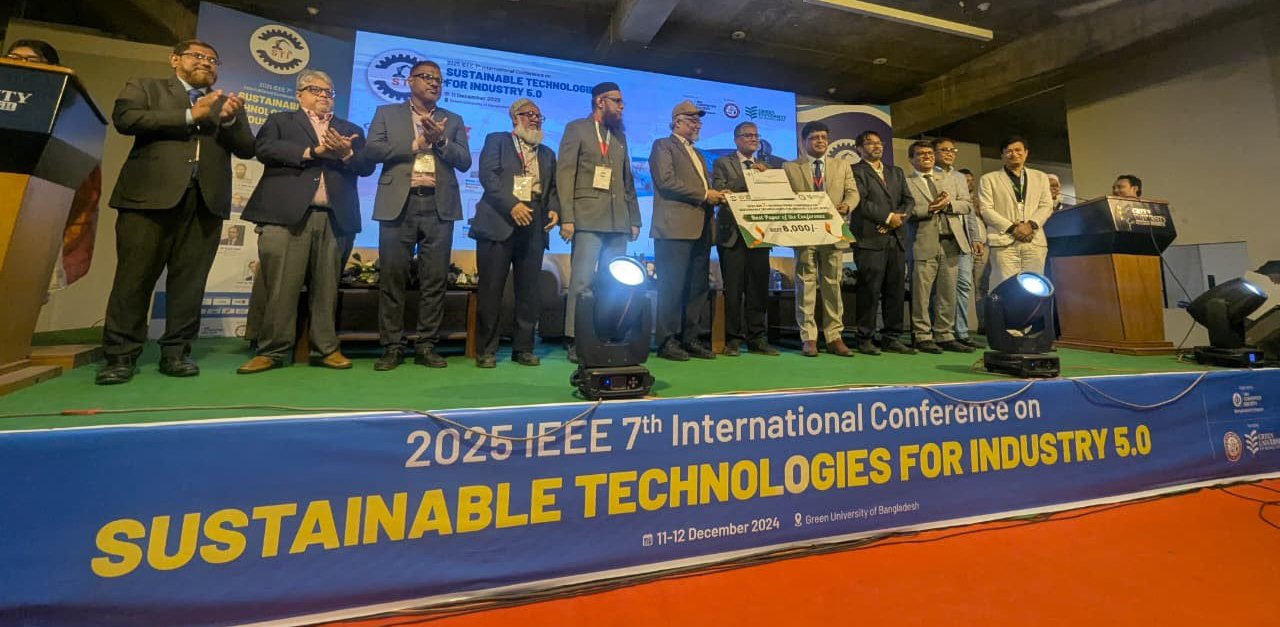
The Department of Computer Science and Engineering (CSE) at the University of Dhaka is proud to announce that the research paper titled "P3FL-HIDS: A Privacy-Preserving Personalized Federated Learning Framework with Byzantine Robustness for Healthcare Intrusion Detection" has been honored with the Best Research Paper Award at the prestigious 2025 7th International Conference on Sustainable Technologies for Industry 5.0 (STI 2025), held in Dhaka on December 11-12, 2025.

The winning paper was authored by Nur Mohammad and Md Maruf Rahman, first-batch students of the Professional Masters in Information and Cyber Security (PMICS) program, alongside their supervisor, Prof. Dr. Md. Abdur Razzaque. The work was presented in Track 1: Intelligent Computing, Networking and Security Systems.

Recognition for Cutting-Edge Research
The conference title, STI, stands for Sustainable Technologies for Industry 5.0. The annual event serves as a premier international platform focused on the emerging paradigms of Industry 5.0, emphasizing human-centric, resilient, and sustainable industrial ecosystems. The selection of the P3FL-HIDS paper underscores the relevance and pioneering nature of the research in advancing secured, intelligent systems.

The authors, Nur Mohammad and Md Maruf Rahman, are part of the inaugural batch of the Professional Masters in Information and Cyber Security (PMICS) program. This program was established to address the critical need for skilled human resources capable of protecting organizational data and ICT infrastructures through state-of-the-art tools and techniques, including Artificial Intelligence and Machine Learning.
Importance and Use Cases of the Research
The research topic addresses a critical global challenge: securing increasingly privacy-sensitive health data.
- Importance: With the exponential growth in electronic health records and high-resolution medical imaging (like MRI-based diagnostics), this data has become highly vulnerable to cyber attacks. The P3FL-HIDS framework is essential for designing privacy-protecting machine learning mechanisms that ensure security, accuracy, and scalability.
- Core Solution: P3FL-HIDS integrates sophisticated techniques like Byzantine-Robust Aggregation, Gradient Masking, and Zero-Knowledge Proof (ZKP) Authentication within a federated learning framework. This combination provides robust adversarial resilience and protection against privacy leakage.
- Use Cases: The framework is specifically developed for privacy-preserving healthcare intrusion detection and MRI-based tumor classification in federated healthcare networks. It allows multiple hospitals to collaboratively train a highly accurate global model without ever sharing their sensitive patient data.
Looking ahead, the research plans to focus on the future prospects of the P3FL-HIDS framework by enhancing its scalability. This will allow the framework to support hundreds of health providers running asynchronously in cross-institutional settings, further cementing its role in sustainable, human-centric healthcare automation.